Zadanie 4
Matura z języka angielskiego, maj 2026, poziom podstawowy
Wymaganie: III.1 — Zdający określa główną myśl fragmentu tekstu (zasady oceniania CKE 2026).
Treść zadania
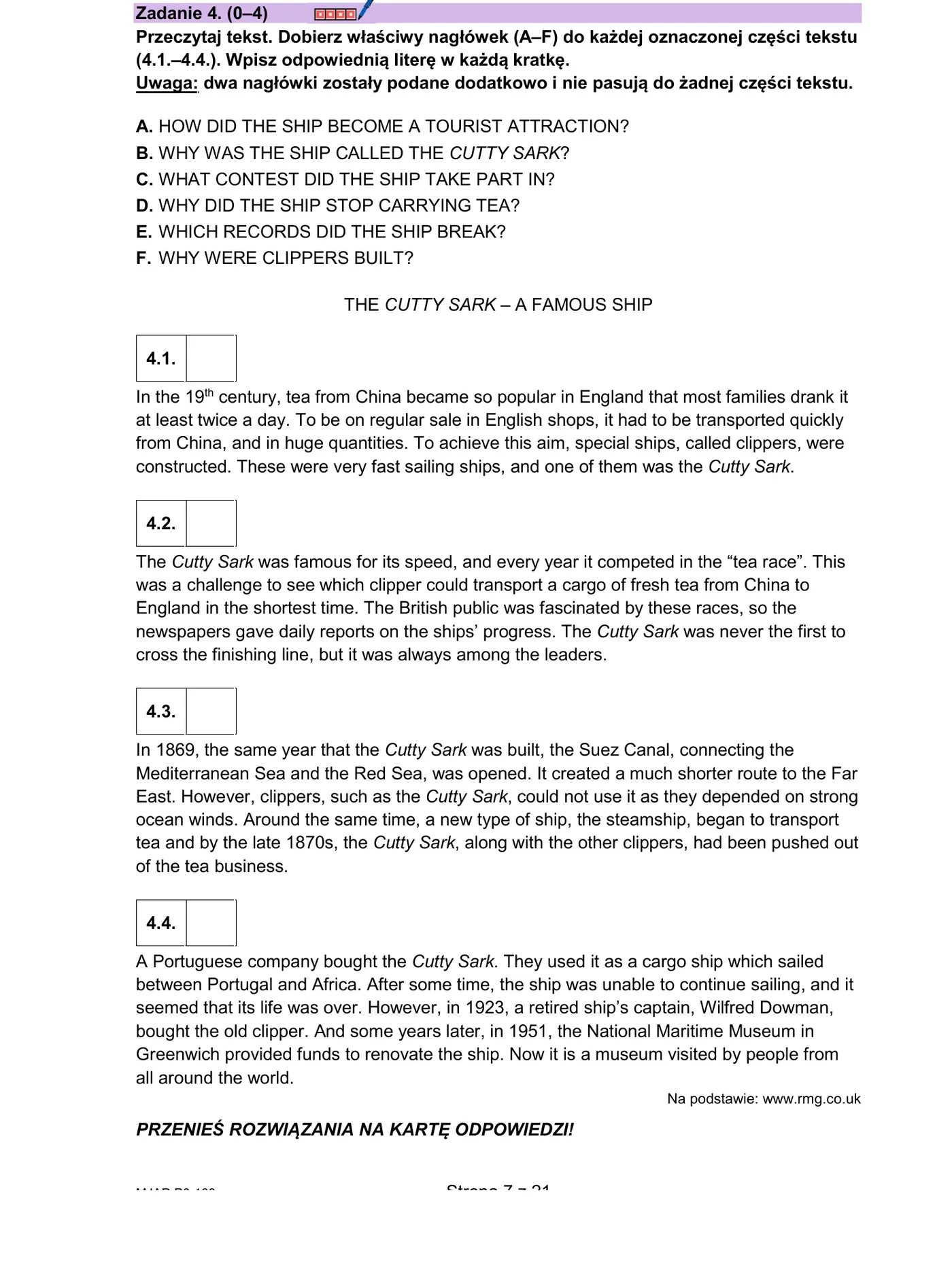
Przeczytaj tekst "The Cutty Sark — a famous ship". Dobierz właściwe nagłówki A-F do 4 części tekstu (4.1-4.4). Dwa nagłówki zbędne.
A. How did the ship become a tourist attraction? B. Why was the ship called the Cutty Sark? C. What contest did the ship take part in? D. Why did the ship stop carrying tea? E. Which records did the ship break? F. Why were clippers built?
Źródło: arkusz CKE MJAP-P0-100-2605. Otwórz oryginalny PDF
Arkusz CKE
Rozwiązanie
- 4.1 = F (Why were clippers built?)
- 4.2 = C (What contest did the ship take part in?)
- 4.3 = D (Why did the ship stop carrying tea?)
- 4.4 = A (How did the ship become a tourist attraction?)
Nagłówki zbędne: B, E.
Klucz według zasad oceniania CKE 2026 (wersja A arkusza).
Uzasadnienia:
- 4.1 = F: herbatę trzeba było przewozić szybko i w dużych ilościach: „To achieve this aim, special ships, called clippers, were constructed.”
- 4.2 = C: część opisuje coroczny „tea race” — „a challenge to see which clipper could transport a cargo of fresh tea from China to England in the shortest time”.
- 4.3 = D: Kanał Sueski i parowce: „by the late 1870s, the Cutty Sark, along with the other clippers, had been pushed out of the tea business”.
- 4.4 = A: renowacja i muzeum: „in 1951, the National Maritime Museum in Greenwich provided funds to renovate the ship. Now it is a museum visited by people from all around the world.”
Pułapka 1 — nagłówek E (rekordy) kusi w części 4.2, bo jest w niej mowa o szybkości statku. Tekst mówi jednak wprost: „The Cutty Sark was never the first to cross the finishing line, but it was always among the leaders.” O żadnym rekordzie nie ma ani słowa — część opisuje wyścig, czyli contest (C).
Pułapka 2 — nagłówek B (nazwa statku) — żadna część tekstu nie wyjaśnia, skąd wzięła się nazwa Cutty Sark.
Typ zadania — reading matching headings
Reading matching = 4 fragmenty tekstu + 6 nagłówków A-F (2 zbędne). Każdy fragment ma dokładnie jeden pasujący nagłówek.
Analiza krok po kroku
4.1 — Era herbaty + budowa clippers:
“In the 19th century, tea from China became so popular in England that most families drank it at least twice a day. To be on regular sale in English shops, it had to be transported quickly from China, and in huge quantities. To achieve this aim, special ships, called clippers, were constructed.”
Klucz: dlaczego budowano clippers — by szybko transportować herbatę. → F. Why were clippers built?
4.2 — Coroczny wyścig herbaciany:
“The Cutty Sark was famous for its speed, and every year it competed in the “tea race”. This was a challenge to see which clipper could transport a cargo of fresh tea from China to England in the shortest time. […] The Cutty Sark was never the first to cross the finishing line, but it was always among the leaders.”
Klucz: w jakich zawodach brał udział statek. → C. What contest did the ship take part in? (nie E — statek nigdy nie wygrał wyścigu, tekst nie mówi o rekordach).
4.3 — Kanał Sueski, koniec ery herbaty:
“In 1869, the same year that the Cutty Sark was built, the Suez Canal, connecting the Mediterranean Sea and the Red Sea, was opened. It created a much shorter route to the Far East. However, clippers, such as the Cutty Sark, could not use it as they depended on strong ocean winds. […] by the late 1870s, the Cutty Sark, along with the other clippers, had been pushed out of the tea business.”
Klucz: dlaczego przestał przewozić herbatę. → D. Why did the ship stop carrying tea?
4.4 — Renowacja, muzeum, turystyka:
“A Portuguese company bought the Cutty Sark… 1923, retired ship’s captain… bought the old clipper. And some years later, in 1951, the National Maritime Museum in Greenwich provided funds to renovate the ship. Now it is a museum visited by people from all around the world.”
Klucz: jak statek stał się atrakcją turystyczną. → A. How did the ship become a tourist attraction?
| Fragment | Nagłówek | Uzasadnienie |
|---|---|---|
| 4.1 | F | budowa clippers dla transportu herbaty |
| 4.2 | C | coroczny wyścig herbaciany („tea race”) |
| 4.3 | D | Kanał Sueski i parowce wyparły clippery z handlu herbatą |
| 4.4 | A | renowacja → muzeum w Greenwich |
Nagłówki zbędne: B (nazwa), E (rekordy) — żadna część tekstu o nich nie mówi.
Punktacja CKE
- 1 pkt za każdy poprawny nagłówek (max 4 pkt).
- 0 pkt za błędny / brakujący.
Klucz uniwersalny — reading matching headings
- Przeczytaj nagłówki A-F PRZED tekstem.
- Czytaj każdy fragment szukając głównej idei (nie wszystkich faktów).
- Dopasuj nagłówek = streszczenie głównej idei fragmentu.
- 2 nagłówki zbędne — nie zmuszaj się do ich użycia.
- Uważaj na pułapki tematyczne — nagłówek może pasować do jednego słowa we fragmencie (tu: „speed”), a nie do jego głównej myśli.
Podobne zadania
czytanie, dopasowanie nagłówków, okładka albumu Abbey Road
Zadanie 4 (4 pkt)
maj 2025 • PP
Przeczytaj tekst „A Famous Cover Photo” o zdjęciu Beatlesów na przejściu dla pieszych przy Abbey Road (okładka albumu „Abbey Road”). Dobierz właściwy nagłówek (A–F) do każdej oznaczonej części tekstu (4.1.–4.4.). Dwa nagłówki zostały podane dodatkowo i nie pasują do żadnej części tekstu. **A.** Choosing a simpler option / **B.** A closer look at the photo / **C.** Some reasons why the band broke up / **D.** A decision taken after consulting fans / **E.** Walking in the footsteps of the Beatles / **F.** The way the photo session was carried out
czytanie, dopasowanie nagłówków A-F do fragmentów
Zadanie 4 (4 pkt)
maj 2024 • PP
Przeczytaj tekst „Underwater Museum” (o podwodnym muzeum rzeźby w Cancún). Dobierz właściwy nagłówek (A–F) do każdej części tekstu (4.1.–4.4.). Dwa nagłówki zostały podane dodatkowo i nie pasują do żadnej części tekstu. **A.** Underwater museum exhibition damaged by divers / **B.** Protecting the sculptures from sea creatures / **C.** An idea to save a place of natural beauty / **D.** Rules and advice for underwater visitors / **E.** Sculptures showing different people / **F.** Various ways to view the sculptures
Rozumiesz, jak to rozwiązać?
Przećwicz podobne typy zadań w aplikacji
matury-online.pl ma tysiące zadań pogrupowanych po dziedzinach. Sprawdź, czy temat „reading, matching headings, Cutty Sark ship” zrobisz samodzielnie.
Otwórz matury-online.pl