Zadanie 9
Matura z języka angielskiego, maj 2025, poziom rozszerzony
Wymaganie: I — Zdający posługuje się dość bogatym zasobem środków językowych (leksykalnych, w tym związków frazeologicznych, gramatycznych, ortograficznych) — zasady oceniania CKE 2025.
Treść zadania
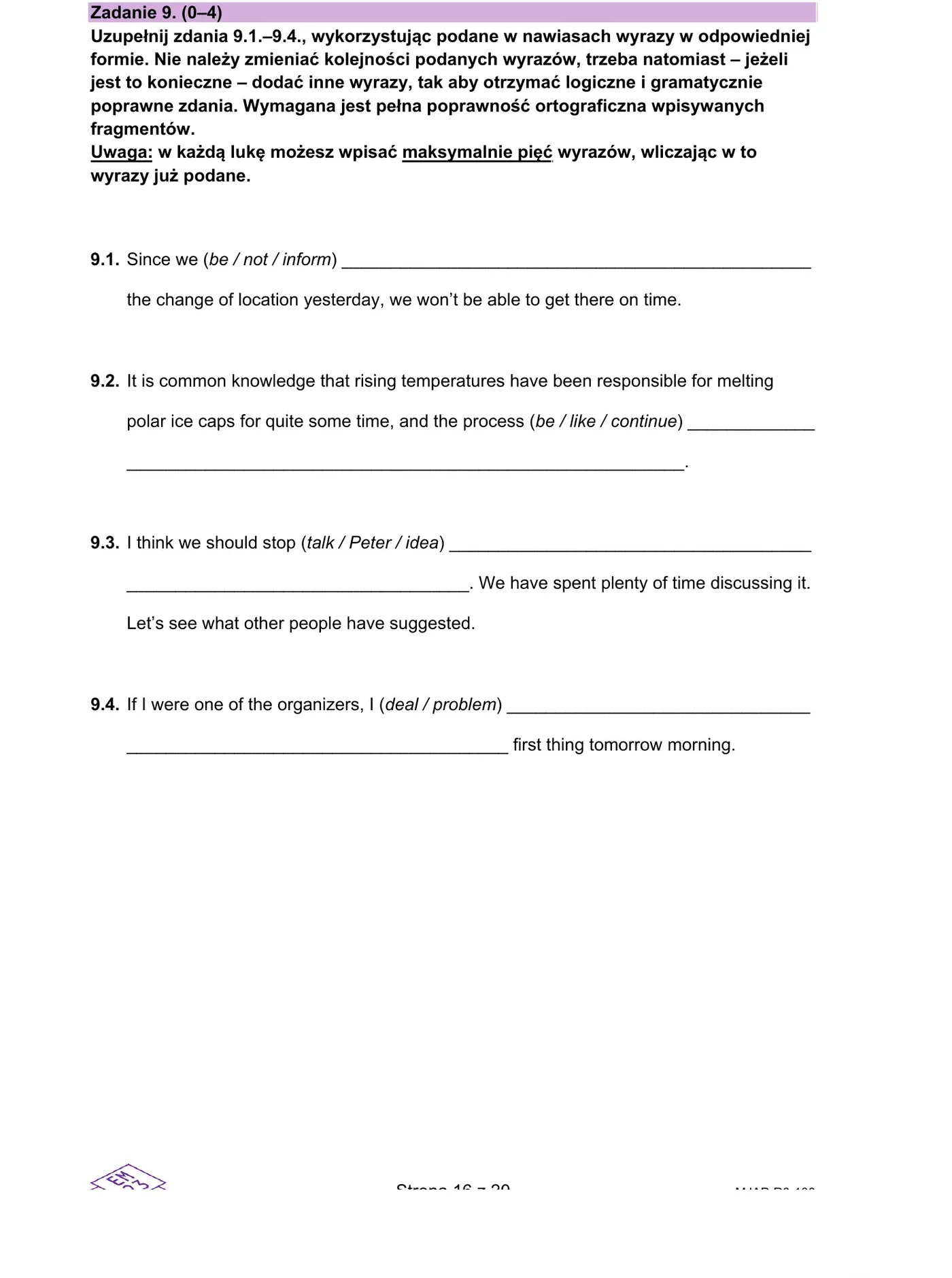
Uzupełnij zdania 9.1.–9.4., wykorzystując podane w nawiasach wyrazy w odpowiedniej formie. Nie należy zmieniać kolejności podanych wyrazów, trzeba natomiast – jeżeli jest to konieczne – dodać inne wyrazy, tak aby otrzymać logiczne i gramatycznie poprawne zdania. Wymagana jest pełna poprawność ortograficzna. W każdą lukę możesz wpisać maksymalnie pięć wyrazów, wliczając wyrazy podane.
- 9.1. Since we (be / not / inform) ___ the change of location yesterday, we won't be able to get there on time.
- 9.2. It is common knowledge that rising temperatures have been responsible for melting polar ice caps for quite some time, and the process (be / like / continue) ___.
- 9.3. I think we should stop (talk / Peter / idea) ___. We have spent plenty of time discussing it. Let's see what other people have suggested.
- 9.4. If I were one of the organizers, I (deal / problem) ___ first thing tomorrow morning.
Źródło: arkusz CKE MJAP-R0-100-2505. Otwórz oryginalny PDF
Arkusz CKE
Rozwiązanie
9.1. — weren't informed of/about / were not given information about / weren't informed before
9.2. — is (very/most) likely to continue / is likely going to continue / is likely to be continuing / will be likely to continue / might/may be likely to continue
9.3. — talking about Peter's idea / talking, Peter, about this idea / talking over Peter's idea / talking Peter into this idea / overtalking Peter's idea / talking Peter's idea out / talking with Peter about ideology
9.4. — would deal with the/this/that/every/each/any problem / would deal with the/these/those/such/any/some problems / would be dealing with problems / could/might deal with the problem
9.1. hadn't/haven't been informed of / hadn't informed of / didn't inform them about / are not informed about / wouldn't be informed about / were not informed on / weren't infromed of / were not informing (about) / could not be informed of/about = 0 pkt (zła forma czasu, zły przyimek, zła konstrukcja).
9.2. is like to continue / was likely to continue / is likely to be continued / isn't likely to continue / is unlikely to continue / will be likely continued / will (most) likely continue / is looking like to continue / most likely will be continued / is likely going to be continue / is probably going to continue / is more likely to continue / would be likely to continue / has been likely to continue / is being likely to continue / will be likely continuing = 0 pkt (zła forma).
9.3. to talk about Peter's idea / talking about Peters' idea / talking about Peter's/Peter/Peters' ideas / talking with Peter / talking to Peter about idea / talking Peter's ideas / talk about Peter's idea / talking of Peter's idea / talking about Peters idea / talking with Peter about these ideas / talking with Peter about the idea / talking the idea over with Peter / talk(s) about Peter's idea / talking about the Peter's idea / talking about Peater's idea = 0 pkt (zła forma lub zła ortografia).
9.4. would deal with a/some problem / would deal a/the problem / deal the problem / will deal with the problem / would make dealing with problems / would deal with the problem as / would have dealt with (the) problem / would be dealed with problem / would deal with problematic / would be dealing with the problem / would deal with problems as = 0 pkt (zła forma).
Strategia: uzupełnianie zdań wyrazami z nawiasu na PR
Wymagana pełna poprawność gramatyczna i ortograficzna. Maksymalnie 5 wyrazów wpisywanych w lukę, łącznie z podanymi.
Podane wyrazy wskazują konstrukcję: “be / not / inform” → strona bierna z przyimkiem (weren’t informed of), “be / like / continue” → “be likely to”, “stop / talk” → “stop + -ing”, “If I were…” → “would + bezokolicznik”. Kolejności podanych wyrazów nie zmieniasz.
Czas, strona, przyimki — wszystko musi pasować do reszty zdania (np. “yesterday” → czas przeszły w 9.1). Drobny błąd = 0 pkt.
Limit: 5 wyrazów. weren't = 1 wyraz. is going to = 3 wyrazy. Policz dokładnie.
Dla zdających z dysleksją
Akceptowane: 9.1. were not infromed of, 9.2. is likely to continu / is likly to continue, 9.3. talkin about Peter's idea, 9.4. would deal wiht the problem.
Punktacja CKE
- 1 pkt — poprawna odpowiedź (za każde z 9.1.–9.4.).
- 0 pkt — odpowiedź niepoprawna albo brak odpowiedzi.
- Maksymalnie 4 pkt.
Rozumiesz, jak to rozwiązać?
Przećwicz podobne typy zadań w aplikacji
matury-online.pl ma tysiące zadań pogrupowanych po dziedzinach. Sprawdź, czy temat „środki językowe PR, uzupełnianie zdań wyrazami z nawiasów (max 5 wyrazów)” zrobisz samodzielnie.
Otwórz matury-online.pl